Norma's Automated Internal Auditor: Risks and Nonconformities That Update Themselves
Instead of waiting for a scheduled internal audit to find gaps, Norma's internal auditor watches your management system continuously and creates or updates Risk and Nonconformity records the moment it finds something.
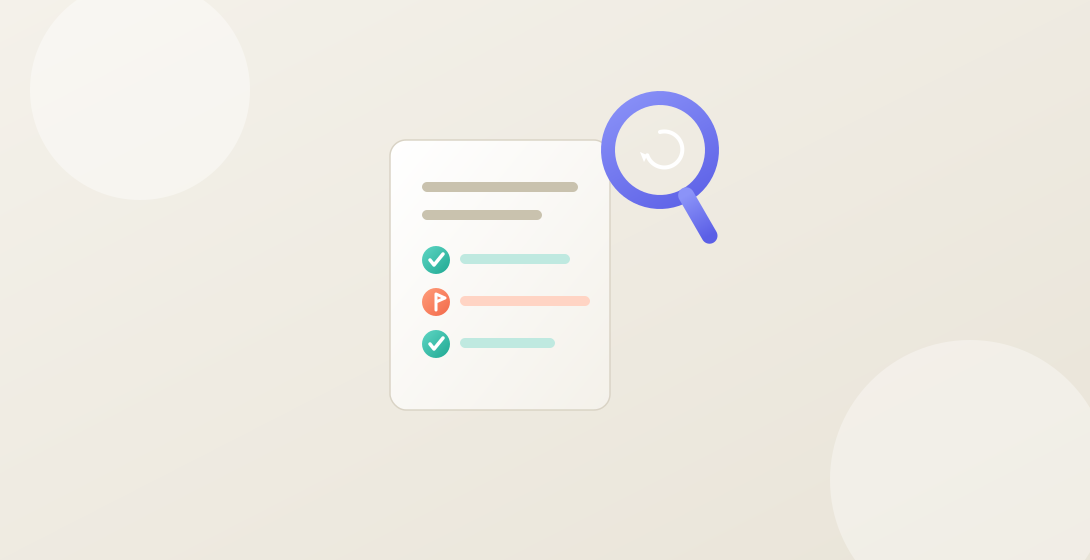
Most internal audits happen on a schedule: quarterly, twice a year, maybe monthly if a team is disciplined about it. Between audits, gaps accumulate quietly, a control stops being followed, a piece of evidence goes stale, a policy nobody updated after a process changed, and nobody notices until the next audit round, or worse, until an external auditor does.
Norma's internal auditor is built to close that gap by not waiting for a scheduled check at all.
What it actually does
The internal auditor runs continuously against your management system: every Control, every Policy, every piece of linked evidence. When it detects something that doesn't hold up, an overdue evidence refresh, a control with no owner, a process that no longer matches its documented procedure, it doesn't just flag it in a report you'll read next quarter. It creates or updates the record that should exist because of that finding.
Concretely, that means:
- A new Risk gets created when the auditor identifies exposure that isn't already tracked, an asset without a corresponding control, a dependency on a supplier with no assessed risk on file.
- A Nonconformity gets opened when a control that should be operating isn't, evidence is missing past its refresh window, or a documented procedure and actual practice have drifted apart.
- Existing records get updated, not duplicated. If a Risk or Nonconformity already exists for something the auditor finds again, it updates the existing record's status and evidence trail instead of creating noise.
Every one of these stays linked back to the Control, Standard, and workspace it came from, so nothing shows up as a disconnected task with no context.
Why this matters more than a scheduled audit
A scheduled internal audit answers "are we compliant right now, on this specific day." Continuous monitoring answers a more useful question: "when did we stop being compliant, and is anyone already working on it." The gap between those two questions is exactly where most audit surprises come from, issues that existed for weeks or months before anyone scheduled a look.
It also means your team's actual audit prep work shrinks. Instead of a scramble two weeks before an external audit to find every gap that accumulated since the last one, the Risk and Nonconformity register is already current, because it's been updating itself the whole time.
What your team still does
The internal auditor doesn't make judgment calls about risk appetite, treatment decisions, or whether a nonconformity is acceptable to carry for a quarter while a fix is planned. It surfaces what changed and creates the record so a human doesn't have to remember to. Someone on your team still reviews, prioritizes, and closes each one, the auditor's job is making sure nothing sits undetected long enough to become a surprise.
Let's Build Your Compliance Success
We know every compliance journey is unique, at your company or your consultancy. Tell us about your requirements and we'll show you how Norma can help.
- Email